
- Michael Allison, CFA

- Apr 5
- 2 min read

By Michael Allison, CFA
The Tide That Moves Everything
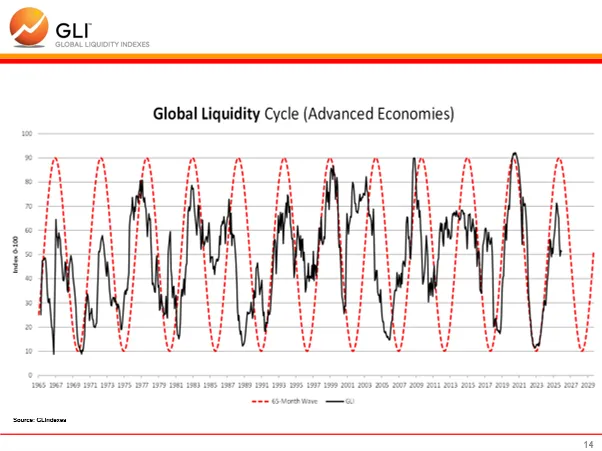
I found this week’s Chart very thought provoking. It tracks the Global Liquidity Cycle for advanced economies going back to 1965. Sixty years of data. The pattern is interesting and shows a near-rhythmic 65-month wave, roughly 5 1/2 years from trough to trough, pulsing through markets like a heartbeat.
Understanding this cycle, I’d argue, is one of the most underappreciated edges that long-term investors can have.
Here’s the core idea: global liquidity: the aggregate availability of money and credit across central banks, commercial banks, and cross-border capital flows, doesn’t move randomly. It oscillates. And those oscillations have historically lined up remarkably well with the broad rhythm of risk asset performance.
When liquidity expands, financial assets generally flourish. When it contracts, not so much.
Think of it like the tide. You can have a beautiful beach, perfect weather, and a great boat, but if the tide is going out, you’re going to have a harder time than you expected.
Which brings me to where we are right now.
As the Chart shows, the current cycle likely peaked somewhere in Q4 2025 or early 2026. The absolute level of global liquidity remains enormous, some estimates put it near $188 trillion. But what matters most to markets is the rate of change, not the level. And the momentum is fading.
Several forces are converging. The Fed has ended quantitative tightening, but the ECB, Bank of England, and Bank of Japan are still shrinking their balance sheets. China’s PBOC has been injecting stimulus, providing a partial offset, but the net effect across advanced economies is a decelerating liquidity environment. Layered on top of that: trillions in global debt requiring refinancing over 2026–2028, rising bond market volatility, and recently a firmer dollar, all of which tend to tighten financial conditions.
None of this means a crash is imminent. Liquidity cycles create headwinds, not cliffs. But it does argue for a more selective, risk-aware posture, particularly for portfolios that were positioned for the tailwind of an expanding cycle.
For investors approaching or already in retirement, this matters enormously. The sequence of returns risk that threatens retirement portfolios is often amplified at exactly these inflection points in the liquidity cycle.
The tide is going out. That doesn’t mean you can’t swim — it just means you need to know where the rocks are.
Source: CrossBorder Capital.
Interested in reading more of Mike's weekly newsletters? Click below to view The Sunday Drive.


.png)