
- Avail Investment Partners

- May 23, 2025
- 2 min read

Choosing the Right Path: Four Ways to Transition
Your choice of successor will define the future of your company. Here are four primary paths, each with distinct advantages and considerations:

1. Transfer to Insiders
If you have trusted partners or long-term employees, an insider transfer may offer the smoothest transition.
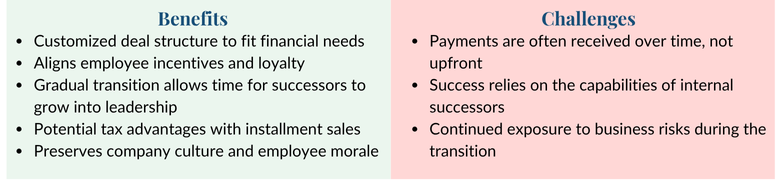
Ideal for: Owners who prioritize culture, employee retention, and phased exits.
2. Transfer to Children: Family Succession
Passing the business to the next generation is a powerful way to keep your values and family identity alive—if done thoughtfully.

Ideal for: Owners with capable, willing children who share their passion for the business.
3. Sale to a Third Party
An external sale, whether to a strategic buyer or a private equity firm, can provide liquidity and a clean exit.

Ideal for: Owners who prioritize financial outcome and swift transitions.
4. Sale to an Employee Stock Ownership Plan (ESOP)
An ESOP allows employees to buy the company through a trust, rewarding them for their loyalty and sustaining company culture.

Ideal for: Owners who want to reward employees, retain the company's identity, and achieve tax-efficient liquidity.
Structuring a Legacy-Focused Transition
Once the right path is chosen, execution is key. A successful transition follows these strategic steps:

Financial Security While Staying True to Your Values
An effective exit strategy also secures your financial future while honoring your principles. Key strategies include:
Tax-Efficient Exit Planning
Installment sales, 1031 exchanges, or 1042 rollovers to defer or reduce capital gains
Charitable giving strategies like CRTs and donor-advised funds
Qualified Small Business Stock (QSBS) exclusions where applicable
Asset Protection & Estate Planning
Trust structures to minimize estate taxes
Buy-sell agreements for insider transitions
Liability protections to safeguard personal wealth
Diversification Post-Sale
Building diversified investment portfolios
Real estate investments, private equity, and passive income strategies
Structured settlements or annuities for reliable income
Philanthropy and Impact Giving
Establish family foundations or endowments
Support scholarships, community projects, or nonprofits
Utilize donor-advised funds for flexible charitable giving
The Emotional Payoff: A Life Beyond Your Business
Imagine five years from today. Your business is still thriving under strong leadership. Your employees are secure. Your company name continues to carry weight and pride in the community.
Meanwhile, you are financially independent, spending time with family, traveling, giving back to causes you believe in.
That’s the true reward of a well-structured, legacy-focused exit.
Conclusion
Selling your business is a profound milestone. When approached thoughtfully, it’s an opportunity to secure your future, reward your employees, sustain your company’s impact—and leave a legacy that lasts.
Planning ahead is crucial. With the right strategies, you can transition your business on your terms and preserve everything you’ve worked so hard to build.
Important Disclosures
Avail and its affiliates do not provide tax or accounting advice. This material has been prepared for informational purposes only, and is not intended to provide, and should not be relied on for, tax or accounting advice. You should consult your own tax and accounting advisors before engaging in any transaction.


.png)