

Updated: 7 hours ago
Executive Summary
Equity indexes ended September mixed but remain close to all-time highs, supported by strong corporate earnings and resilient economic growth, despite higher interest rates and elevated geopolitical uncertainty.
The Federal Reserve (Fed) raised interest rates 0.25% (or 25 basis points) during the month, the first rate hike since July 2023, as stronger economic momentum, persistent inflation, and renewed energy-price pressure reinforced a more hawkish policy stance.
US Treasury yields continued to rise throughout September, with the 10-year US Treasury yield reaching levels not seen since the early 2000s, pressuring bond returns but creating more attractive opportunities for fixed-income investors.
Midterm campaigns are in full swing as we end the third quarter, and history suggests that despite near-term volatility as we approach election day, investors are generally best served by maintaining a disciplined, long-term investment approach.
Equity Markets Mixed in September
Large-cap technology stocks led markets higher during a month in which many other parts of the equity market struggled. Meta, AMD, Intel, and Micron all rallied during the month, lifting the Nasdaq Composite index, a proxy for large-cap tech stocks, by approximately 1.9%. The S&P 500 index, a proxy for large-cap US stocks, slipped slightly, down approximately 0.4%. Small-cap, foreign, and emerging market stocks all retreated during the month, as well, as the combination of ongoing geopolitical stress, higher energy prices, and rising interest rates made for a difficult environment.[1]
Fortunately, September’s mixed results built upon strong returns earlier this year. As you can see, all the equity indexes below are up 10% or more after the first three quarters of the year. Emerging market stocks remain in the leadership position, but the tech-heavy Nasdaq Composite has been slowly catching up.

Economic Growth Accelerating
There are several crosscurrents in markets and the economy right now, many of which we address in the remainder of the piece. However, some encouraging economic news may have flown under the radar in September. For example, the Atlanta Fed’s GDPNow model, a real-time estimate of current-quarter economic growth based on incoming data, ended the quarter tracking approximately 3.7% (well above its 2.7% average since May 2024).[2] This suggests the US economy entered the fall with more momentum than many expected.
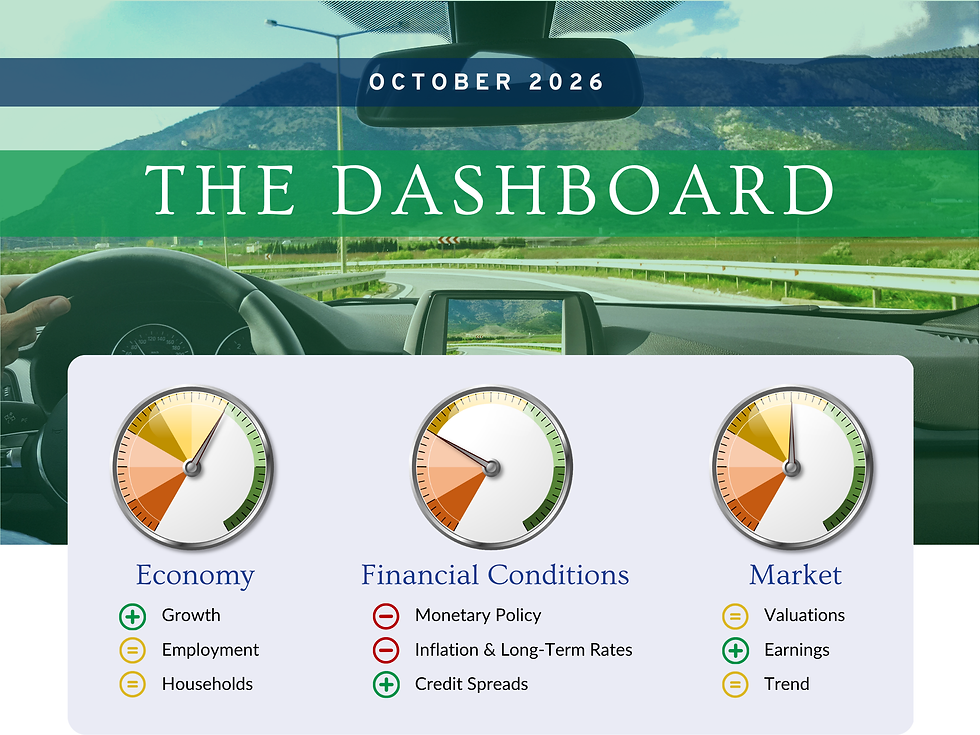
S&P Global’s September PMI survey data tells a similar story. Business activity strengthened across the major developed global economies, with the US standing out as the clear growth leader. US output growth accelerated to its fastest pace since July 2021, with S&P Global estimating the reading to be consistent with roughly 5% annualized GDP growth.[3] When you consider these strong economic indicators alongside low unemployment figures (4.2% as of October 2), the US economy appears to be on relatively solid footing despite higher interest rates and persistent inflation (we increased Growth to positive and moved the Economy dial up one notch from last month).
AI Build-Out Driving Economic Growth
We have discussed the material impact that AI is having on economic growth in previous pieces. However, a recent piece from the Wall Street Journal provides historical context for just how massive the AI infrastructure spending is projected to become.
The piece states “the AI build-out is on track to become the biggest economic bet in U.S. history, dwarfing the investments made to fund other huge U.S. infrastructure projects such as the railroads, the highway system and the plumbing for the internet.” As you can see below, AI infrastructure spending is projected to total $10.3 trillion, or an average of 3.63% of US GDP from 2025 to 2032 according to the Brookings Institution. If this comes to fruition, the AI infrastructure buildout that we are currently experiencing would outpace all other infrastructure projects of the past two hundred years.[4]
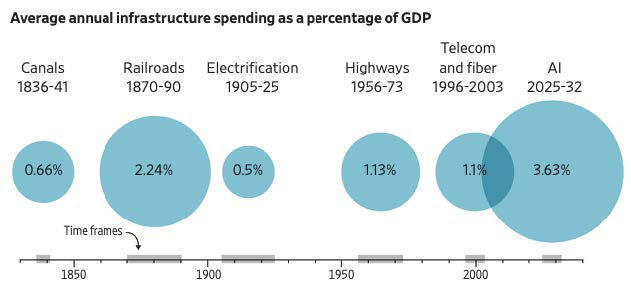
The article goes on to describe both positive and negative aspects of this AI buildout (as we attempted to do in our July Dashboard). The positives include the boost AI infrastructure spending is providing to our economy. In addition to the Brookings Institution’s multiyear projection above, Goldman Sachs estimates that AI investment will hit 1.9% of US GDP in 2026. You have to travel back to the railroad boom of the late 1800s to find a time in which one industry accounted for such a large share of the economy.[5]
The buildout is also putting certain workers, such as data annotators, engineers, and electricians, in high demand. LinkedIn estimates that AI was behind more than 750,000 new jobs in the US from 2023 through 2026. Kory Kantenga, an economist from LinkedIn, stated, “it’s one of the robust areas of a very slow labor market.”
However, the AI boom brings negative aspects with it, as well. We have discussed the stock market concentration many times before; the economic concentration described above adds to it. If the AI story gets challenged in some way (through regulation, competition from China, damaging cybersecurity events, etc.), the health of the stock market and the US economy may be in jeopardy.
In addition, we are seeing AI demand consuming capital, resources, and energy that could be used elsewhere. One example from capital markets is the sizable issuance of debt by hyperscalers to fund infrastructure projects like data centers, which may be one of the potential drivers behind US Treasury yields rising (more on that in the section below). In addition, construction spending for anything other than data centers has fallen off sharply in the last year and is now well below its 2023 level (see below).

In some ways, AI remains both a blessing and a curse from an economic and investment perspective. It is driving incredible economic growth and wealth in the form of rising stock prices in AI-related companies. However, it is also creating economic and financial concentration while crowding out competing objectives.
The Fed Hike and Upward Pressure on Yields
The Federal Reserve raised rates 0.25% in September, with the unanimous decision marking the first interest rate hike since July 2023. Fed officials’ projections, also known as the dot plot, show most anticipate at least one more interest rate hike in 2026. Chair Kevin Warsh pointed to stalled progress in lowering inflation and a strong economic foundation (as mentioned above) as reasons to move forward with the hike. Warsh stated, “New hiring, private sector earnings, business capital investment – each of these markers has improved in recent months and is pointing in a good direction.” [6]
Rising global yields also made headlines in September. In the US, 10-year Treasury yields hit their highest level in 24 years, topping out just above 5.3%. The pace of the rise also caught investors’ attention. The increase of the 10-year Treasury yield during the quarter, just shy of 0.9%, was the largest quarterly jump since 1994.[7] Rising yields were not isolated to the US, either, as yields in the United Kingdom, Germany, and Japan climbed alongside US Treasury yields (see below).[8]
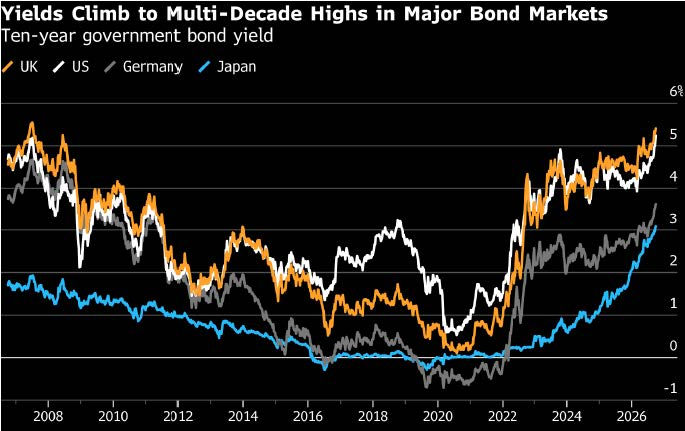
There are several potential reasons for yields rising. However, it is not easy to pin blame on any single issue and there can be different drivers depending on what part of the yield curve we’re discussing. The front end of the curve, meaning shorter-dated US Treasuries, is heavily influenced by the federal funds rate and expectations for future Fed policy. As discussed earlier, inflation has remained stickier than anticipated, with higher energy prices related to the conflict with Iran, the ongoing Russia-Ukraine war, and tariffs all contributing to inflationary pressures. The Fed raised the federal funds rate in September and has signaled that more increases may be necessary, putting upward pressure on shorter-term yields, including the 2-year Treasury.
Longer-term Treasury yields are influenced by a broader set of factors. In our opinion, stronger-than-anticipated economic growth, persistent fiscal deficits, reduced Fed forward guidance, and heavy corporate bond issuance (including borrowing by AI hyperscalers mentioned above), have all contributed to upward pressure on longer-term yields.
Rising yields created a challenging environment for bond returns over the past quarter. The Bloomberg US Aggregate Bond Index fell again in September and is now down about 2.9% year to date. Gold (S&P GSCI Gold index) also fell during the month and is approximately 3.6% lower than it began the year. Commodities have been one consistent bright spot in 2026, as geopolitical turmoil and supply concerns have driven the price of energy and other commodities higher. The Bloomberg Commodity Index rose modestly in September and is up nearly 33% year to date.

While rising rates have pressured bond prices, higher starting yields may offer fixed income investors and savers more attractive income opportunities than have been available for much of the last decade. For long-term investors, today’s higher yields may represent a relatively attractive entry point, providing greater income potential and larger cushion against future interest rate volatility.
The Path Forward – AI & The Midterm Elections
Alongside rising yields and stronger-than-expected economic growth, artificial intelligence remained one of the dominant forces shaping markets throughout September. AI-related investment continues to support corporate spending and economic activity, even as questions surrounding the technology’s risks and regulatory framework have intensified.
Dario Amodei, head of Anthropic (maker of Claude), called out the need to pace frontier models in the wake of several high-profile cybersecurity breaches in the past few months, including one involving a swarm of OpenAI agents attacking AI platform Hugging Face and attacks on other government websites. Somewhat surprisingly, his rivals Sam Altman of OpenAI and Elon Musk of xAI both supported his proposal for a coordinated slowdown, marking a rare moment of agreement between three AI leaders who typically agree on very little.[9]
Politicians of different stripes are also finding common ground in opposition to the pace and scale of AI development. Vermont Senator Bernie Sanders and Steve Bannon, political strategist and former Senior Counselor to President Trump during his first presidency, jointly urged Congress to set guardrails on AI.[10] Whether these calls to slow down and create regulation for AI gain traction remain to be seen, as President Trump and others oppose the idea.
Anthropic also circulated its highly anticipated initial public offering (IPO) prospectus (referred to as Form S-1) in late September, and it is expected to be one of the highest-valued IPOs in history. However, the prospectus devotes nearly a third of the content to detailing the various risks posed by AI. Those include standard investment risks, such as concentration in its customer base and an operating loss of about $8 billion last year, but also language not usually found in S-1 filings – “existential risks to humanity.”[11]
If you find it somewhat surreal that a company hoping to IPO at record valuations feels the need to publicly remind people that it may pose a threat to humanity itself, you are not alone. We find ourselves in a paradoxical situation in which AI is driving our economy and markets forward, while also raising fears about our jobs, our communities, and for some, even our existence.
However, for all the attention AI receives in financial markets, it remains well behind more immediate economic concerns for most voters. Cost of living, jobs, political corruption, and other pocketbook issues continue to rank higher heading into November’s midterm elections. AI and data-center development will likely be part of political conversation, but only one piece of a much broader debate.

As this piece is published, we are about a month away from the midterm elections. Not surprisingly, political rhetoric is amplified and will most likely remain so through the election. We encourage investors across the political spectrum to separate the signal (underlying economic and market fundamentals) from the noise (rhetoric) surrounding the election. History suggests that letting your emotions about an election drive your financial decisions typically does not work out well.
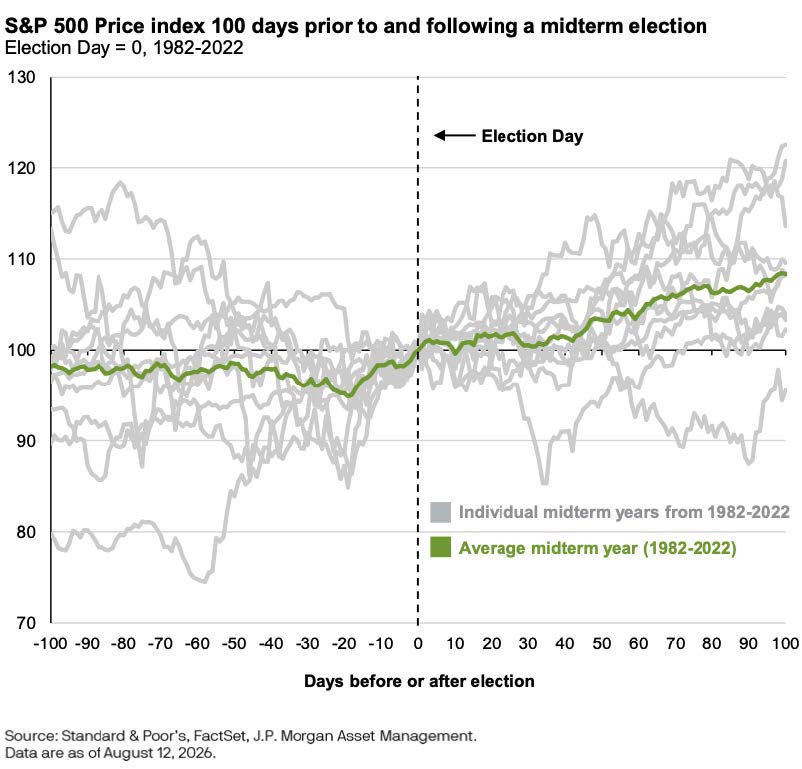
J.P. Morgan provides two charts below worth considering. The first illustrates the average S&P 500 index price movement over the 100 days before and after the election. As you can see, average prices historically tend to fall in the lead-up to the election but then rise afterward as uncertainty around the result fades away.[12]
The second chart illustrates how both the S&P 500 index price return and Real US Gross Domestic Product (GDP) have fared in Republican-led, Democratic-led, and Divided Government configurations over time. Again, the averages suggest that the market and economy can perform well regardless of the election results.

If nothing else, the past few years have demonstrated the resilience of both the US economy and financial markets. Businesses have continued to adapt to a rapidly changing environment, supporting solid economic growth and corporate earnings even as investors have navigated inflation, higher interest rates, geopolitical uncertainty and technological disruption. These crosscurrents are unlikely to disappear, but history suggests that maintaining diversification, focusing on long-term fundamentals and avoiding emotionally driven investment decisions remain important disciplines through periods of uncertainty.
As always, we appreciate your continued trust and welcome the opportunity to speak with you in greater detail regarding your specific situation.
[1] Source: YCharts, October 1, 2026.
[2] Source: Atlanta Federal Reserve, October 1, 2026. https://www.atlantafed.org/research-and-data/data/gdpnow
[3] Source: S&P Global, “Advanced economies report further growth in September, but US outperformance widens”, September 24, 2026. https://www.spglobal.com/market-intelligence/en/news-insights/research/2026/09/advanced-economies-report-further-growth-in-september-but-us-outperformance-widens
[4] Source: Wall Street Journal, “The AI Build-Out Is Becoming the Biggest Economic Bet in US History,” September 23, 2026. https://www.wsj.com/economy/the-ai-build-out-is-becoming-the-biggest-economic-bet-in-u-s-history-c60716dd?mod=WTRN_pos9
[5] Source: Wall Street Journal, “The AI Build-Out Is Becoming the Biggest Economic Bet in US History,” September 23, 2026. https://www.wsj.com/economy/the-ai-build-out-is-becoming-the-biggest-economic-bet-in-u-s-history-c60716dd?mod=WTRN_pos9
[6] Source: Financial Times, “Federal Reserve defies Donald Trump with first rate rise since 2023,” September 16, 2026. https://www.ft.com/content/f5ce5c38-76e3-4212-8c60-4c868f6dee70?syn-25a6b1a6=1
[7] Source: Wall Street Journal, “Stock Market News, Sept. 30, 2026: 10-Year Treasury Yield Rises to New 24-Year High,” September 30, 2026. https://www.wsj.com/livecoverage/stock-market-today-dow-sp-500-nasdaq-09-30-2026?mod=hp_lead_pos1
[8] Source: Bloomberg, October 1, 2026
[9] Source: Financial Times, “Rivals Altman and Musk rally behind Dario Amodei’s call for an AI slowdown,” September 12, 2026. https://www.ft.com/content/31220b59-b0c6-401c-a146-2b7b5d138837?syn-25a6b1a6=1
[10] Source: Financial Times, Steve Bannon and Bernie Sanders unite in AI safety call,” September 14, 2026. https://www.ft.com/content/bab5c4c5-5377-4dd0-8b46-d8c4ce9a36d5?syn-25a6b1a6=1
[11] Source: Financial Times, “Anthropic warns of ‘existential risk to humanity’ in IPO prospectus,” September 28, 2026. https://www.ft.com/content/c7685a7e-7745-4cbc-8053-4958d0ea449b?syn-25a6b1a6=1
[12] Source: J.P. Morgan Asset Management, “2026 Midterm Elections,” August 2026.
Important Information
Past performance may not be representative of future results. All investments are subject to loss. Forecasts regarding the market or economy are subject to a wide range of possible outcomes. The views presented in this market update may prove to be inaccurate for a variety of factors. These views are as of the date listed above and are subject to change based on changes in fundamental economic or market-related data.
Content is provided by Investment Research Partners, LLC. All data and information reference herein are from sources believed to be reliable. Any opinions, news, research, analyses, prices, or other information contained in this research is provided as general market commentary, it does not constitute investment advice. IRP shall not in any way be liable for claims, and makes no expressed or implied representations or warranties as to the accuracy or completeness of the data and other information, or for statements or errors contained in or omissions from the obtained data and information referenced herein. The data and information are provided as of the date referenced, and such data and information are subject to change without notice.
IRP employs artificial intelligence using a number of platforms for the purpose of researching investments and comparing various investment platforms. IRP has evaluated the security of these AI platforms, and does not use any platform that uses client information to train its models or that maintains sensitive client information in its records. Further, human input is required by IRP policy to ensure accuracy of the information generated by AI, and any data aggregation or document summaries. The use of these platforms will be reviewed periodically to ensure confidentiality and accuracy as well as efficiency.
Certain third-party sources cited in this material may require a paid subscription or may otherwise be located behind a paywall. If you would like more information regarding any cited source, please contact IRP and we will provide additional details upon request. Please contact your Advisor in order to discuss your specific situation.

Click below to view our October 2026 Market Outlook video

.png)