

By Michael Allison, CFA
The 99.7% Discount: AI, Aging, and the Reinvention of Work
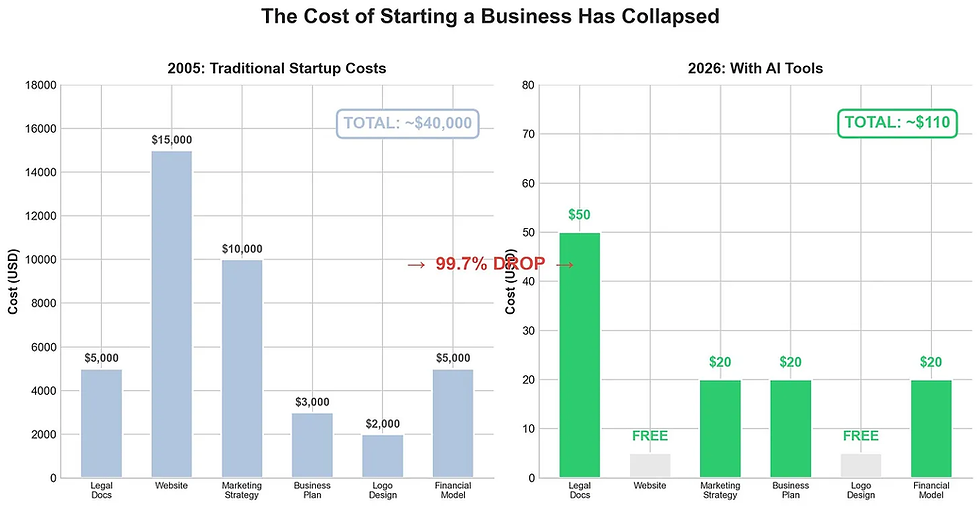
Take a long look at this week’s Chart.
In 2005, launching even a modest business required $40,000 or more in upfront costs: legal documents, a website, marketing strategy, business plan, logo, financial model. Today, the same toolkit costs roughly $100. That’s a 99.7% drop in twenty years, with most of the collapse occurring in the last 36 months.
If you’re not a small business owner, you might shrug at this. You shouldn’t. Because the chart isn’t really about startups — it’s about the option value of leaving the system, and who is finally able to exercise that option.
The conventional story about AI and work is that it’s coming for the young. The recent college graduate, the entry-level analyst, the junior associate, those are the jobs that get hollowed out first.
There’s truth to that, and the implication is worth flagging: the traditional apprenticeship ladder is being compressed at the bottom. Where do you learn the craft if AI is doing the entry-level work? I don’t think anyone has a good answer yet.
But there’s a less-told story that’s quietly perhaps more important, and it shows up in the data.
According to Peter Diamandis, the mean age of founders behind the top 0.1% fastest-growing companies in America is 45, not 25. Americans aged 55 to 64 are one of the fastest-growing segments of new entrepreneurs, and the 70-to-80 cohort has shown the steepest acceleration since 2020.
From November 2025 through January of this year, Americans filed 1.56 million new business applications — the highest three-month total since the government began tracking the data in 2004.
That’s not a tech-bro story. That’s a demographic story.
Here’s why it matters.
For decades, the implicit deal in white-collar work was: trade your twenties and thirties for skill, your forties and fifties for compensation, and exit through a retirement door that, increasingly, nobody can comfortably walk through.
Longer life expectancies, gutted defined benefit plans, and equity markets that don’t always cooperate have made the traditional glide path more aspirational than actual.
What AI changes is the exit ramp.
Brian Clark, writing at Further, frames the shift cleanly: the most valuable workers in the AI economy are no longer “knowledge workers”, they’re outcome producers. Information is now essentially free.
What AI can’t do is own the result. It can analyze your client’s marketing problem; it can’t be held accountable for solving it. It can draft the strategy; it can’t guarantee the implementation. That accountability, backed by judgment, pattern recognition, and a network built over decades, is precisely what older professionals already have. AI is demolishing the team-of-fifteen that used to be required to translate that judgment into deliverables.
The people best positioned to thrive in the AI economy may not be the digital natives. They may be the analog veterans with AI as a force multiplier.
I’ll admit my bias here. I retired after a 22-year career at Eaton Vance at the end of 2021 and launched New Lantern Capital the following year. Shortly after that, I joined forces with Investment Research Partners, another young entrepreneurial venture and a group of kindred spirits. This week’s Chart isn’t an abstraction to us, it represents a tailwind we’re currently riding.
The economic and investing implications could be very interesting. We’re entering a period where the labor market bifurcates more sharply: the top of the experience curve and the bottom of the cost curve both win. The middle, mid-career knowledge workers who don’t own outcomes and aren’t senior enough to direct them, gets squeezed. And if a meaningful share of 55-to-75-year-olds opts into entrepreneurship rather than retirement, the second-order effects on consumer spending, healthcare demand, real estate, and Social Security claiming behavior are all non-trivial. Speculative, but certainly worth watching.
The Takeaway: The chart at the top isn’t a story about software costs. It’s a story about agency. For the first time in modern economic history, the optimal time to start a business may not be at 25 — it may be at 55, or 65, or 70. The barriers haven’t just fallen; they’ve inverted. Experience used to be expensive to monetize without a firm behind you. Now it’s the most leverageable asset you own.
If you’ve spent thirty-five years accumulating expertise and you’re wondering what’s next, the data is telling you something. You owe it yourself to listen.
Sources: Peter Diamandis, “Can Anyone Become an Entrepreneur?” (Metatrends, 04/23/2026); Brian Clark, “From Knowledge Worker to Outcome Producer in the Age of AI” (Further, 04/21/2026).
Interested in reading more of Mike's weekly newsletters? Click below to view The Sunday Drive.


.png)